How Do 2-Week Diet Breaks Prevent Adaptive Thermogenesis?
Implementing 2-week diet breaks during a cut alternates 14 days in an energy deficit with 14 days at energy balance. This structure of intermittent energy restriction attenuates adaptive thermogenesis, prevents drops in resting metabolic rate, and lowers ghrelin far more effectively than continuous linear dieting in resistance-trained athletes.
Prolonged energetic deficits trigger adaptive thermogenesis—a metabolic suppression where total daily energy expenditure drops beyond what loss of tissue mass explains. Circulating triiodothyronine (T3) levels decline, sympathetic nervous system output slows, and mitochondrial efficiency increases. Consequently, cellular baseline maintenance and non-exercise activity thermogenesis consume fewer calories per hour.
Continuous calorie restriction forces the endocrine system into defensive energy conservation. A 2024 trial published in MDPI Nutrients demonstrated that intermittent energy restriction protocols preserve resting metabolic rate significantly better than continuous linear deficits over multi-week fat loss phases. Resting energy availability at predicted maintenance for 14 continuous days restores active thyroid hormone production and supplies adequate energy substrate to halt adaptive metabolic decline.
Dropping energy intake below the threshold of 30 kcal/kg of fat-free mass for more than 14 consecutive days consistently triggers these systemic energy-saving adaptations. Two full weeks of re-feeding at neutral energy balance interrupt this adaptive cycle before neuroendocrine signaling suppresses involuntary physical movement.
Why Are 2-Week Diet Breaks Better Than 2-Day Refeeds?
A 48-hour refeed temporarily restores liver glycogen and suppresses muscle tissue breakdown. However, two days is insufficient time to reverse suppressed thyroid output or restore lowered resting energy expenditure. While a brief glycogen boost fills muscle bellies and improves short-term performance, it fails to eliminate adaptive thermogenesis over a 12 to 16-week cutting phase.
A 2-week diet break provides 14 uninterrupted days at energy balance. This extended timeline gives the neuroendocrine system enough time to signal energy sufficiency to the hypothalamus. Serum leptin levels normalize, which signals the central nervous system to resume standard metabolic output.
While a 2-day carb refeed retains lean muscle mass during short cutting phases, it cannot match the psychological or physiological reset of a 14-day maintenance block. The Intermittent vs Continuous Energy Restriction in Resistance-Trained Athletes (ICECAP) protocol uses these 14-day energy balance blocks to maximize fat loss per week spent dieting while completely preserving fat-free mass.

How Does Intermittent Energy Restriction Fix Leptin and Ghrelin?
Adipocytes secrete leptin to signal peripheral energy storage levels directly to the brain. During a continuous deficit, circulating leptin drops far faster than body fat decreases. This severe reduction downregulates thyroid activity, reduces luteinizing hormone secretion, and drives hyper-palatable food cravings through neuropeptide Y pathways.
Ghrelin acts as leptin's opposing hormone, driving gastric hunger signals up as energy intake drops. Extended deficits elevate baseline ghrelin concentrations, leaving athletes in a state of persistent food focus and elevated stress markers.
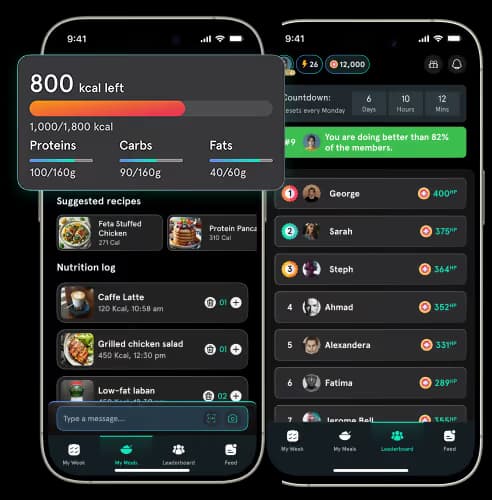
Spending 14 days at maintenance calories restores leptin production and drives circulating ghrelin back to baseline. Lowering these hunger signals restores dietary control before starting the next deficit block. Transitioning between phases requires tight tracking; maintaining precise energy balance on break weeks prevents accidental hyper-caloric intake. Athletes who use meal logging by photo, chat or manual entry manage target adjustments instantly without disrupting daily routines.

How Do You Calculate Maintenance Calories for the ICECAP Protocol?
Adjust your baseline calories for the total weight lost before setting maintenance targets for a diet break. Returning to pre-cut intake levels creates an unwanted calorie surplus because body mass and non-exercise activity thermogenesis have both decreased.
Recalculate your energy baseline with our TDEE Calculator using your updated body weight in kilograms multiplied by 22 to estimate baseline resting metabolic rate. Apply an activity factor between 1.375 and 1.75 based on weekly resistance training and cardio volume. Alternatively, derive energy intake requirements from measured fat-free mass.
Structure macronutrients systematically across the 14-day maintenance window:
- Protein: Maintain 2.2 to 2.6 g/kg of total body mass to optimize muscle protein synthesis. Calculate precise requirements through protein targets derived from fat-free mass.
- Carbohydrates: Increase carbohydrate intake to fill the newly available calories, aiming for 4.0 to 6.0 g/kg to fully saturate glycogen stores and boost T3 conversion.
- Fats: Keep dietary fat at a floor of 20% to 25% of total calorie intake. Reference the dietary fat floor to protect testosterone levels to ensure endogenous hormone production stays stable.
Set up these exact target distributions across deficit and maintenance phases in our Macro Calculator.
How Should You Schedule Diet Breaks During a Fat Loss Phase?
Execute the ICECAP protocol on a planned calendar schedule rather than reacting when exhaustion sets in. Schedule diet break cycles based on starting body fat percentage and training load.
Athletes under 10% body fat require a 2-weeks-on, 2-weeks-off cadence (14 days deficit, 14 days maintenance). Athletes between 10% and 15% body fat perform best on a 3-weeks-on, 2-weeks-off rotation. Lifters above 15% body fat can run 4 to 6 weeks in a deficit before introducing a 2-week maintenance break.
Maintain training load and mechanical tension throughout the maintenance block. Increased glycogen availability supports higher workout volume and progressive overload on primary compound lifts. Athletes who maintain a personal saved-meals library transition between low-carbohydrate deficit days and high-carbohydrate maintenance days without rebuilding whole daily meal plans.
A research review on Examine.com confirms that intermittent energy restriction prevents progressive declines in spontaneous movement. Energy availability during diet breaks increases involuntary physical activity, making it easier to maintain step counts without adding low-intensity steady-state cardio.
A study indexed in pubmed.ncbi.nlm.nih.gov highlights that tracking body weight trends against caloric intake isolates true fat loss from fluid shifts. Increased carbohydrate intake loads intramuscular glycogen and water, adding 1.0 to 2.0 kg of scale weight in the first 72 hours of a diet break. Reviewing a weekly nutrition summary and meal history reveals true weight trends through these normal fluid fluctuations, preventing false alarms about fat regain.
Frequently Asked Questions
Do 2-week diet breaks slow down long-term fat loss?
Diet breaks extend the total calendar duration required to reach a specific body fat target, but they preserve total fat loss efficiency. By maintaining resting metabolic rate and fat-free mass, lifters lose a higher percentage of fat relative to total weight lost compared to continuous linear dieting.
Will you gain body fat during a 2-week diet break?
You will gain 1.0 to 2.0 kg of scale weight during the first 3 to 5 days of a diet break. This weight increase reflects replenished muscle glycogen and associated water, not adipose tissue accumulation. As long as caloric intake matches recalculated maintenance, true body fat gain remains zero.
Should training volume change during a diet break?
Keep training intensity and exercise volume high throughout the 14-day maintenance block. Elevated carbohydrate intake increases glycogen availability, allowing you to train with higher loads and achieve performance PRs. Use the maintenance period to apply progressive overload to primary compound lifts rather than reducing resistance or volume.
How do you distinguish between needing a diet break versus a 2-day refeed?
If you experience persistent strength loss, poor sleep, low sex drive, and chronic thermal coldness, a 2-day refeed is insufficient. These physiological markers signal deep neuroendocrine downregulation. A full 2-week diet break at maintenance energy availability is required to restore thyroid output, leptin levels, and baseline metabolic rate.
Can a 1-week diet break replace a 2-week diet break?
A 1-week break provides psychological relief and partially restores glycogen, but research shows it takes up to 14 full days at energy balance for thyroid hormones, leptin levels, and resting metabolic rate to recover to baseline values after extended caloric deficits.
Pacing an intermittent energy restriction strategy requires precise macronutrient transitions between 14-day deficit blocks and 14-day maintenance periods. Tracking these shifts against fluid changes ensures that performance stays high while metabolic adaptation remains suppressed. Use TrainMate to structure your macronutrient targets and track your long-term energy expenditure automatically across every block of your cut.